

First, the good news: you're closer than you think
Every week a .NET developer asks us some version of the same worried question: "Do I need to leave .NET and become a data scientist to stay relevant?"
No. In fact, the opposite is true. Most companies adopting AI don't need people who invent models — they need engineers who can put AI to work inside real business applications: reliable, secure, tested, and deployed. That is exactly what experienced .NET developers already know how to do. The AI part is the smaller half of the gap.
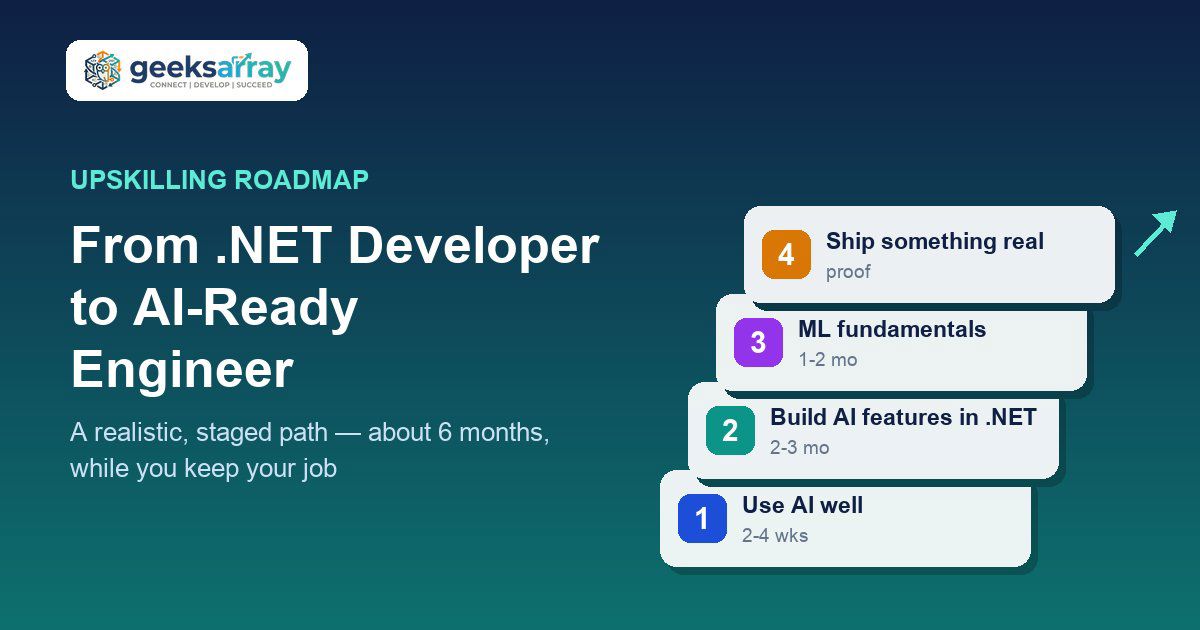
Here's the staged roadmap we recommend — realistic for someone with a full-time job.
Stage 1: Become genuinely good at using AI (2–4 weeks)
Before building AI features, learn to work with AI daily. Not casual chatting — deliberate skill:
- Use an AI assistant for code review, test generation, and refactoring — and learn where it's reliably wrong, because that judgment is the skill employers notice.
- Practice writing precise prompts with context, constraints, and examples. Treat it like learning a new API surface.
- Let AI explain unfamiliar code and concepts to you. Your learning speed roughly doubles, which pays for the rest of this roadmap.
Most developers stop here and call themselves "AI-ready." This is the entry ticket, not the destination.
Stage 2: Build AI-powered features in .NET (2–3 months)
This is the stage that changes your resume. The .NET ecosystem now has first-class tools for AI work — you don't need to switch languages:
- Calling AI services: learn to integrate large-language-model APIs into an ASP.NET Core application properly — streaming responses, retries, timeouts, cost controls, and caching. This is engineering, and it's where you already shine.
- Retrieval (RAG): the most in-demand AI pattern in enterprises — letting AI answer questions over company documents and data. Learn embeddings and vector search conceptually, then build one end to end.
- Orchestration: chaining AI steps with your business logic — validations, fallbacks, human review points. Enterprises pay well for people who do this safely.
One finished project here — an AI feature inside a normal .NET application, deployed and demonstrable — is worth more than any certificate.
Stage 3: Learn just enough ML fundamentals (1–2 months, in parallel)
You don't need the math degree. You need the vocabulary and the judgment:
- What models can and can't do; why they hallucinate; what "training" vs "fine-tuning" vs "prompting" actually mean and cost.
- How to evaluate AI output systematically instead of eyeballing it — this is the difference between a demo and a product.
- Basic data literacy: what makes data usable, and why most AI project failures are data failures.
This stage turns you from "developer who calls an API" into an engineer who can be trusted with AI decisions.
Stage 4: Ship something real and talk about it
The roadmap completes when there's proof. Pick a real problem from your own work domain — support-ticket triage, document search, report drafting — and build it properly: tested, secured, deployed, with costs measured.
Then write about it or present it. In interviews, one honest sentence — "I built this, here's what went wrong and what it costs to run" — outperforms every buzzword.
What to ignore (for now)
Half of AI upskilling is knowing what to skip. Unless you're changing careers entirely: skip training your own models from scratch, skip GPU infrastructure, and skip the research-paper treadmill. The enterprise demand — and the salary jump — is in applying AI well, not inventing it.
The realistic timeline
Six months, part-time, while working. Stage 1 immediately, Stage 2 as your core effort, Stage 3 in parallel evenings, Stage 4 as the finish line. Developers who follow a staged path like this finish; developers who start with a 60-hour "everything AI" video dump usually don't.
The .NET skills you've built for years are not the thing AI replaces. They're the foundation AI needs. The developers who win this transition are the ones who add AI to strong engineering — not the ones who abandon engineering to chase AI.
GeeksTech runs mentor-led batches for .NET developers adding AI skills — live sessions, real projects, honest guidance on what to skip. Visit our institute page or message us on WhatsApp.
Comments (0)
No comments yet — be the first to share your thoughts.